
AI Peer Network: Just enough AI
Event description
AI tools like ChatGPT, Claude, Gemini and Copilot are now embedded in everyday work. But behind them sit energy-intensive data centres, rising carbon emissions, and complex data systems.
For charities and social purpose businesses across the South West, this raises critical questions:
How sustainable is our use of AI?
What are the hidden environmental costs?
And what does responsible adoption really look like?
Join Tech4Good South West and GreenPT for a practical AI Peer Network session exploring how to reduce AI’s environmental footprint – without losing its benefits.
We’re joined by:
James Martin, digital sustainability expert and Founder of BetterTech
Robert Keus, co-founder of GreenPT, who will introduce a more resource-efficient approach to AI.
What is the problem?
Large AI models rely on significant energy and global data infrastructure. As adoption grows, so do carbon emissions, data governance concerns, and the tension between innovation and environmental responsibility.
What is the solution?
James will establish the facts about AI’s environmental impacts, and what we can do to limit them.
Robert will demonstrate how GreenPT reduces compute demand and environmental impact while still delivering practical value.
What are the pitfalls?
Hidden environmental costs
Overuse of AI where simpler tools would suffice
Data location and governance risks
Sustainability overlooked in digital strategy
What are the opportunities?
Used intentionally, AI can still improve efficiency, support small teams, and enable innovation – while aligning with climate and sustainability goals.
How to get started safely
We’ll share practical guidance on:
Assessing when AI is truly needed
Reviewing your organisation’s AI use
Reducing environmental impact in digital workflows
Online event information
This is an online event
You will get the Zoom link on registration
Share buttons
Share event
https://tickets.mp/ZXZlbnQ6ODQyOQ==This event has already happened.
This event finished and tickets are no longer available.
Explore more eventsThis event has already happened.
This event finished and tickets are no longer available.
Explore more events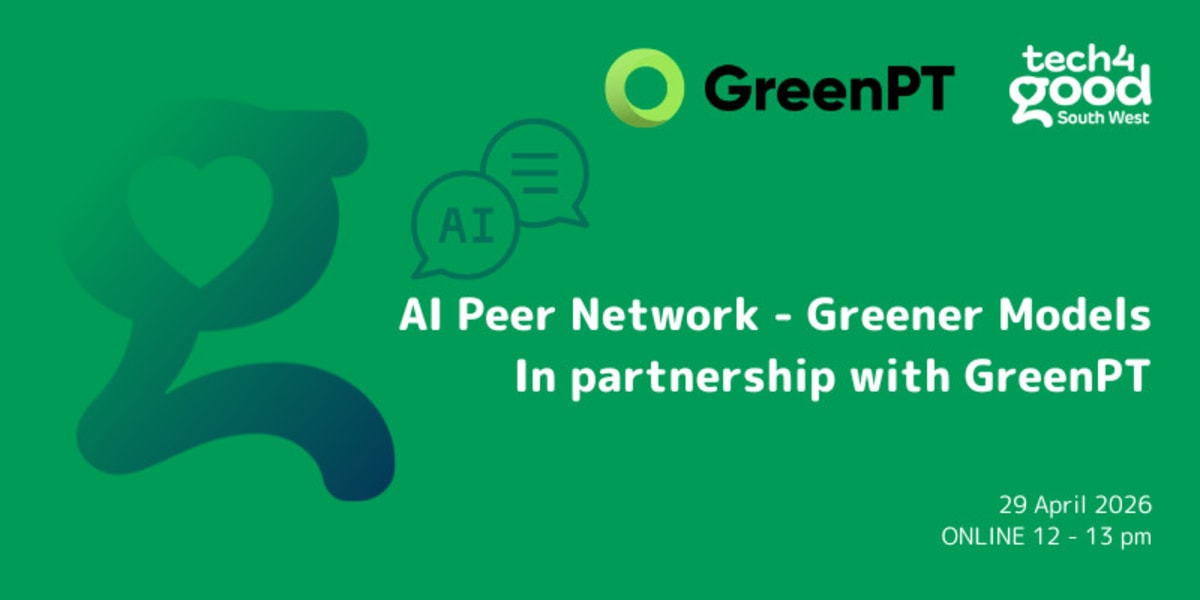
Details
- Event name
- AI Peer Network: Just enough AI
- Start date
- to
Online event details
This is an online event
You will get the Zoom link on registration
Description
AI tools like ChatGPT, Claude, Gemini and Copilot are now embedded in everyday work. But behind them sit energy-intensive data centres, rising carbon emissions, and complex data systems.
For charities and social purpose businesses across the South West, this raises critical questions:
How sustainable is our use of AI?
What are the hidden environmental costs?
And what does responsible adoption really look like?
Join Tech4Good South West and GreenPT for a practical AI Peer Network session exploring how to reduce AI’s environmental footprint – without losing its benefits.
We’re joined by:
James Martin, digital sustainability expert and Founder of BetterTech
Robert Keus, co-founder of GreenPT, who will introduce a more resource-efficient approach to AI.
What is the problem?
Large AI models rely on significant energy and global data infrastructure. As adoption grows, so do carbon emissions, data governance concerns, and the tension between innovation and environmental responsibility.
What is the solution?
James will establish the facts about AI’s environmental impacts, and what we can do to limit them.
Robert will demonstrate how GreenPT reduces compute demand and environmental impact while still delivering practical value.
What are the pitfalls?
Hidden environmental costs
Overuse of AI where simpler tools would suffice
Data location and governance risks
Sustainability overlooked in digital strategy
What are the opportunities?
Used intentionally, AI can still improve efficiency, support small teams, and enable innovation – while aligning with climate and sustainability goals.
How to get started safely
We’ll share practical guidance on:
Assessing when AI is truly needed
Reviewing your organisation’s AI use
Reducing environmental impact in digital workflows
Share event
https://tickets.mp/ZXZlbnQ6ODQyOQ==This event has already happened.
This event finished and tickets are no longer available.
Explore more eventsThis event has already happened.
This event finished and tickets are no longer available.
Explore more events